Whether weatherboards should be repaired or replaced depends on how deep and how widespread the decay is, the condition of the timber around it, the reason the boards failed in the first place and the significance of the existing material. There is rarely a single answer for a whole building. Many properties need a combination of careful repair and selective replacement, renewing the boards that have genuinely failed while retaining the sound timber alongside them. The honest position is that repair is often the right starting point, but not always the right answer for every board.
Start With the Cause, Not Just the Visible Damage
Before deciding between repair and replacement, it is worth understanding why the boards have failed. Rotten or failing weatherboards are usually the result of timber staying damp for long periods, and the visible damage is often a symptom of something else going on. We have covered this in detail in a separate guide on why timber weatherboards begin to rot, and it is the natural first step in any decision about what to do next.
The reason it matters here is simple. Renewing boards without dealing with a leaking gutter, a failed coating, exposed joints, restricted drying or poor detailing tends to let the same problem come back. New timber installed without resolving the source of moisture may also deteriorate prematurely. So the first question is not really repair or replace at all. It is what has been keeping this timber wet, and can that be put right as part of the work.
What Does Weatherboard Repair Actually Mean?
Repair is not one single thing. It covers a range of approaches, and a well judged job often uses several of them on the same elevation. It helps to know what the options actually involve.
Localised Timber Repairs
Where most of a board is sound but a small area has begun to deteriorate, a localised repair addresses the affected part while leaving the rest in place. This suits early or contained decay, particularly where it has been caught before it has spread through the thickness of the board. The value of this approach is that it keeps intervention to a minimum and retains as much of the original board as possible.
Splice Repairs
When the lower end of a long board has failed but the length above it remains sound, the decayed section can sometimes be cut out and a new piece spliced in on a matching profile. Done well, a splice keeps a good deal of the original timber and is barely noticeable once finished. It is not suitable in every location or for every board. The join needs to fall where it stays protected from standing water, and the remaining timber has to be genuinely sound, so a splice is a considered decision rather than a default.
Refixed or Secured Boards
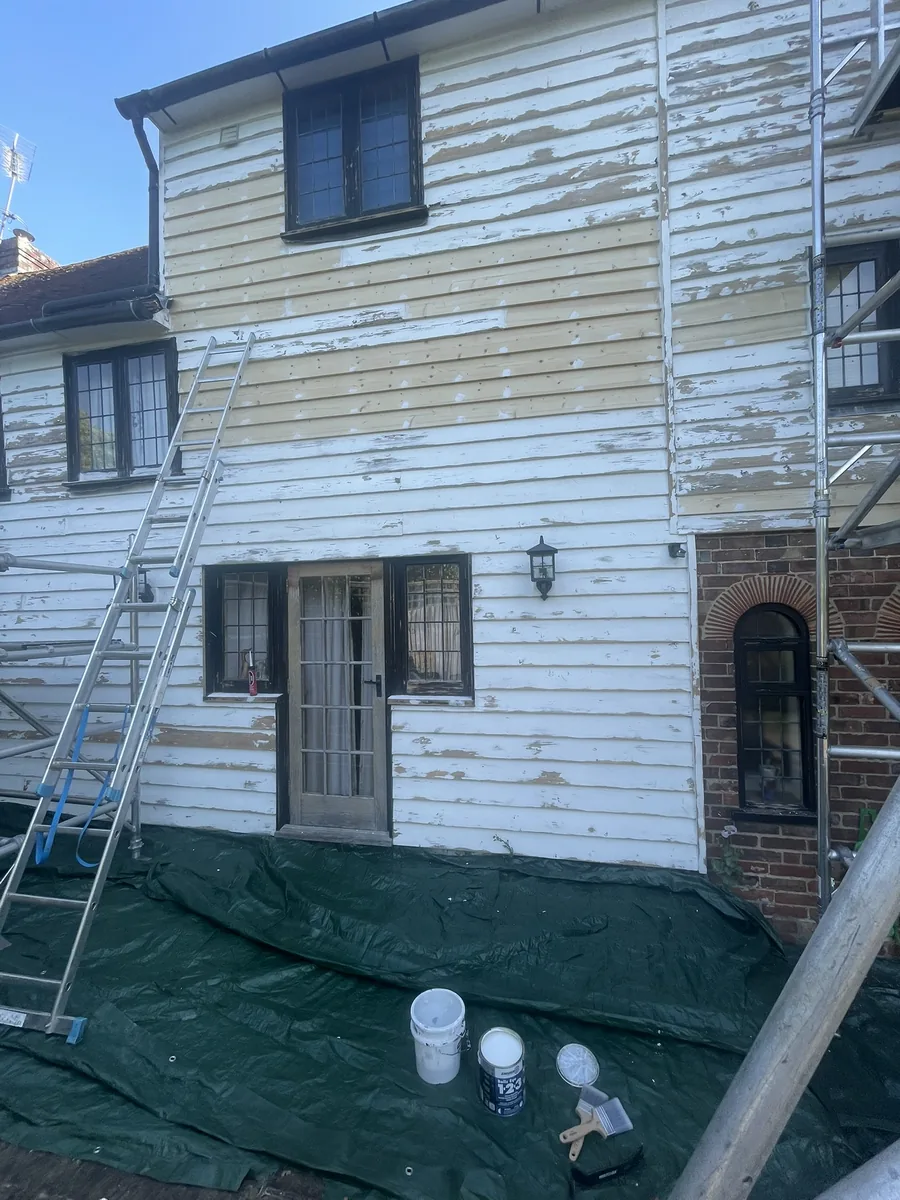
Not every board that has moved is a board that has failed. Boards can work loose or pull away from the frame while the timber itself is still perfectly serviceable. In those cases the board may only need refixing securely, once the reason it moved in the first place has been understood. On the listed oast house near Rye shown below, a number of boards that had simply worked loose over the years were saved and refixed rather than replaced.
Replacement of Individual Boards
Replacing a single failed board can still sit firmly within a repair first approach. Where one board has rotted through but its neighbours remain serviceable, that board can be taken out and renewed on a matching profile while everything sound around it stays put. This is the opposite of stripping an elevation. It is a targeted renewal that keeps the rest of the historic boarding intact, and it is central to how we approach heritage weatherboard repairs.
Signs That Repair May Be Practical
Some situations point towards repair being a realistic option. The following are worth looking for:
- deterioration confined to a short section rather than spread across the elevation
- sound, firm timber remaining around the affected area
- isolated decay at a board end, a joint or around a fixing
- one or two failed boards among otherwise sound boarding
- an existing profile that can be matched accurately
- a specific, correctable cause behind the failure, such as a leaking downpipe
- original boards that still retain sufficient strength and integrity
These are indicators rather than guarantees. A board can look sound from the ground and prove soft once it is examined closely, and decay can travel further behind the paint than the surface suggests. A surface inspection from ground level is a starting point, not a diagnosis, which is why a closer look is normally needed before anyone can say with confidence that a repair will last.
When Replacement May Be Necessary
Repair is not always enough, and it would be dishonest to pretend otherwise. Replacement may be the appropriate course where:
- the timber has lost its structural or practical integrity
- decay runs deeply through much of the board rather than sitting at one end
- deterioration is widespread across an elevation
- boards are extensively split, distorted or unstable
- repeated earlier repairs to the same area have failed
- unsuitable earlier replacement has created continuing problems
- the profile or detailing cannot be retained through a sensible repair
- boards need removing to reach and address a significant problem behind them
The wording here matters. The presence of one of these signs in one place does not mean an entire property needs stripping. It means that particular board, or that particular section, may be beyond a durable repair. The judgement is always about extent and location, and about whether a repair would genuinely hold up over the years or simply defer the problem. Where renewal is the better course, our sympathetic weatherboard replacement is carried out to match what is already there.
Selective Replacement Rather Than Stripping Everything
This is the point that most often gets lost. The choice is rarely repair every single board or replace the entire property. On most buildings the right answer sits between those two extremes, and a sensible project draws on more than one approach at once. In practice, work might involve:
- repairing one elevation while another needs little more than attention to the paint
- replacing only the most exposed section that has borne the worst of the weather
- renewing the lower courses while retaining sound boards higher up
- replacing individual failed boards among sound neighbours
- retaining historic material on sheltered elevations that have survived well
- combining repair, refixing and replacement within the same project
The thread running through all of this is that decisions should follow the actual condition of the building rather than what happens to be convenient. Replacing a whole elevation because one section has failed can sometimes be simpler to specify, but on a period or listed property it may mean discarding sound original timber that still has many years of service left.
Why Original Timber Is Worth Retaining
There are good reasons to keep sound historic fabric wherever it can do its job. Original boarding carries the character of the building and the marks of how it was made. It holds the established profiles, widths and spacings that a modern equivalent only approximates, and it forms part of the evidence of how the property was constructed. Every board that is kept is one less unnecessary intervention, and one less chance of losing an original detail that cannot be put back once it has gone.
None of this is a reason to romanticise failed timber. A board that can no longer keep water out, hold a fixing or carry its own weight is not protecting the building by staying in place. Retaining material for its own sake, past the point where it performs, simply allows the underlying problem to continue and can put the sound timber around it at risk. The aim is to keep what remains genuinely serviceable and to renew what has truly failed, not to save everything regardless of its condition.
Matching Replacement Weatherboards Properly
Where boards do need renewing, replacement is not simply a matter of buying timber that looks roughly similar. A replacement that is not properly matched stands out, and on a listed or period property it can do real harm to the character of the elevation. Getting it right means paying attention to a number of things together:
- the board profile and how it sheds water
- the width and thickness of the existing boards
- the overlap and the way the boards sit against one another
- board orientation and the coursing across the elevation
- the type and placement of fixings
- corner details and how the boarding turns and stops
- the trims and detailing around windows and doors
- thorough surface preparation and a suitable, breathable finishing system
- how the new work meets and interacts with the existing construction
Suitable timber should be selected according to the property and its exposure rather than assuming a single answer fits every case. Different buildings, elevations and budgets call for different choices, and the sensible finish depends as much on how the wall behaves as on the boards themselves. What matters is that the replacement sits naturally within the elevation and lets the timber move and dry.
Paint Condition Can Be Misleading
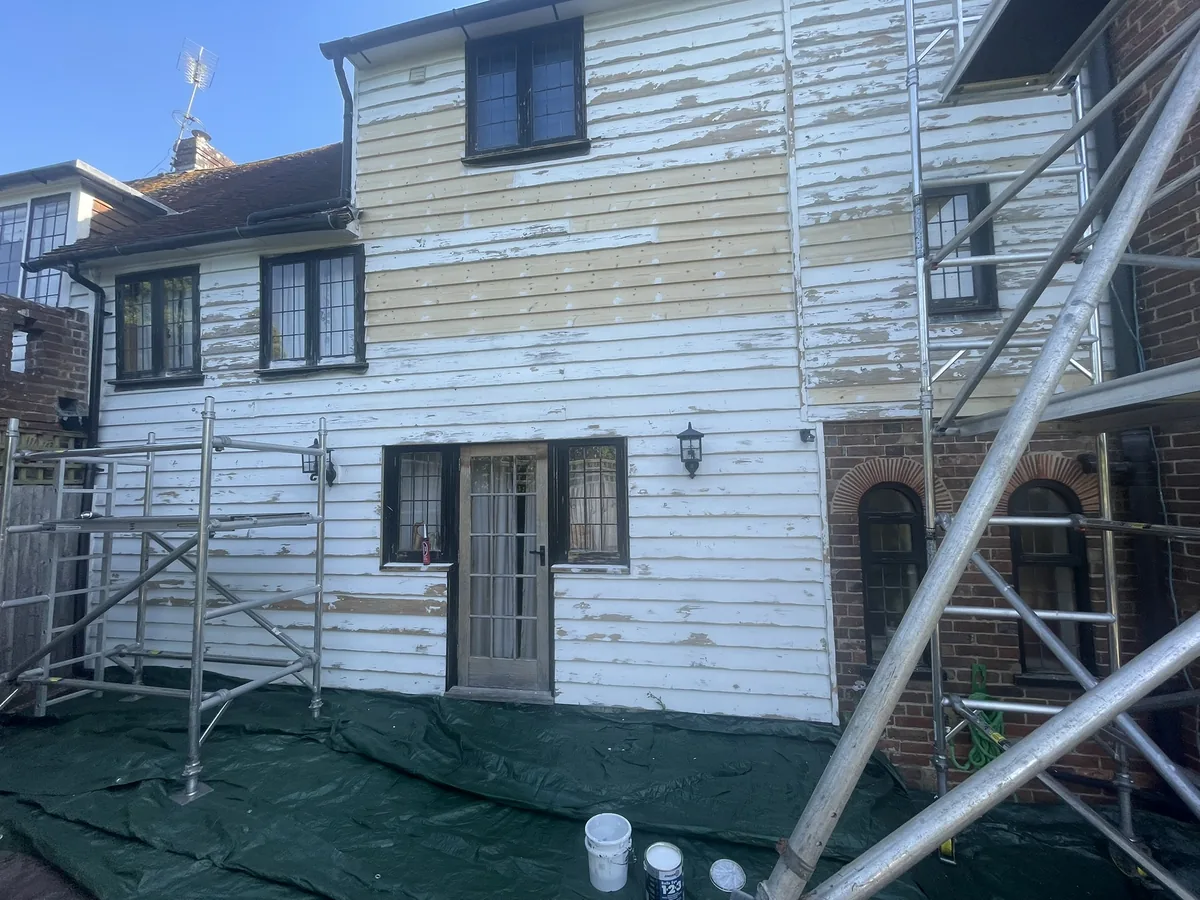
Tired paintwork is not the same thing as rotten timber. It is easy to look at a flaking elevation and assume the boards are finished, when in many cases the timber beneath is sound and simply needs proper preparation and a fresh, breathable coating. Equally, paint that looks reasonable can occasionally hide deterioration behind it, which is why appearance alone does not settle the question either way.
The things worth investigating include paint that flakes or bubbles repeatedly in the same place, dark staining that lingers after dry spells, timber that feels soft to the touch, joints that have opened and localised failures around fixings, corners or openings. Where the boards are sound, thorough weatherboard preparation and painting may be all that is needed. Where they are not, no amount of paint will put right what has already broken down.
Listed and Period Properties Need an Individual Approach
On a listed or period property the decision carries more weight, because the weatherboarding is part of what gives the building its significance. Before any work begins it is worth considering the original fabric, the significance of the building, the established board profiles, the materials used before, the way the property was constructed, and any conservation area requirements that apply. These considerations often shape whether repair or replacement is appropriate, and how any replacement should be carried out.
There is also the question of permissions. Listed building consent, or other approval, may be needed for some changes or for more extensive replacement, and the position is not always clear cut. Like-for-like repair is frequently treated pragmatically, but that is not a guarantee, and more significant work can be viewed differently. Where there is any uncertainty, the right step is to seek guidance from the relevant local planning authority or conservation officer before work starts. We can carry out the work sympathetically, but we do not provide legal advice on consent, and it would be wrong to suggest that all repairs are automatically exempt, that all repairs need consent, that all like-for-like work is automatically permitted, or that we can authorise listed building work ourselves.
Questions We Consider During an Assessment
Every building is different, so an assessment is a matter of judgement rather than running down an identical checklist. That said, the same practical questions tend to guide the thinking:
- What caused the deterioration in the first place?
- How much sound timber remains in and around the affected area?
- Is the decay confined to one area or spread more widely?
- Are the surrounding boards still serviceable?
- Can the original profile be retained or accurately matched?
- Is there any damage behind the boarding that needs addressing?
- Will the timber be able to dry out after the work is finished?
- Are the gutters, downpipes or roof details contributing to the problem?
- Is listed building or conservation advice needed before proceeding?
- Would a repair provide a genuinely durable result, or only defer the issue?
Working through questions like these is what turns a first impression into a considered recommendation. It is also why an honest answer usually needs a proper look at the building rather than a snap verdict from a photograph.
Repair, Replace or Use a Combination?
In practice, many projects end up as a combination of approaches rather than one or the other. The following are general examples of how the same principles play out differently depending on the building. They are illustrations, not specific properties.
Example one. A listed cottage with two rotten lower boards, where the rest of the boarding is sound. Here, replacing those individual boards on a matching profile and carrying out localised repairs may preserve the remainder and keep intervention to a minimum.
Example two. An exposed elevation with widespread decay that has already been patched more than once. In this case, selectively renewing that whole elevation may provide a more durable result than repeatedly repairing areas that continue to fail.
Example three. A property with failing, flaking paint but sound timber underneath. Here, thorough preparation and repainting with a suitable breathable system may be all that is genuinely needed, with no board replacement at all.
The point of these examples is that the same starting complaint, tired-looking weatherboarding, can lead to three quite different and equally correct answers. You can see the range of approaches across our recent projects.
Arrange a Weatherboard Assessment
The right answer depends on what remains sound, how far the deterioration has spread and why the boards have failed. A careful assessment can distinguish between timber that looks tired but remains serviceable, boards that can be repaired, and areas where selective replacement is the more durable option. Rather than assume the worst or paper over the problem, it is worth understanding the true condition of the boarding before deciding what the building actually needs.
Common Questions
Is it cheaper to repair weatherboards than replace them?
Sometimes, but not always. Where decay is confined to a small area, a localised repair is often the more economical choice as well as the more sympathetic one. Where deterioration is widespread, or where the same section has been patched repeatedly, ongoing repairs can end up costing more over time than renewing that part properly. Cost depends on the extent of the work, access and the condition of the surrounding timber, so it is not something anyone can judge honestly without looking at the building.
Can only the rotten section of a weatherboard be replaced?
Often, yes. Where a board has failed at its lower end or around a joint but the remainder is sound, the decayed section can sometimes be cut out and a new length spliced in on a matching profile. This is not right for every board or every position, and a splice needs to be made where it will stay protected. Whether it is the sensible option depends on how far the decay reaches and where the join would fall.
Do all boards need replacing if one board is rotten?
No. A single failed board does not condemn an elevation. In many cases one or two boards can be renewed while the sound boarding around them is retained. Replacing everything because one board has gone is rarely necessary and usually means losing original timber that still has years left in it. The exception is where the decay in one board is a sign of a wider problem affecting the boards around it, which is why the surrounding timber is always checked.
How can you tell whether timber is sound beneath the paint?
Paint can hide a good deal, so appearance alone is not enough. Sound timber feels firm and resists gentle pressure, whereas decayed timber feels soft, spongy or crumbles at the edges. Open joints, dark staining that lingers in dry weather and paint that repeatedly fails in the same spot are all worth investigating. A close inspection of the timber itself is normally needed to judge condition reliably, rather than a verdict from the ground.
Should old weatherboards always be preserved?
Sound original boards are well worth keeping, because they carry the character and the established profiles of the building and replacing them needlessly is a loss. That said, retaining timber that has genuinely broken down does not protect a building. If a board can no longer keep water out or hold a fixing, keeping it in place simply lets the problem continue. The aim is to save what remains serviceable and renew only what has truly failed.
Does replacing weatherboards on a listed building require consent?
It can do. On a listed building the weatherboarding is part of the protected fabric, and more extensive replacement or any change to its character may require listed building consent, while sympathetic like-for-like repair is often treated more pragmatically. The position is not always clear cut. The sensible step is an early conversation with your local planning authority or conservation officer where there is any doubt. We carry out the work sympathetically but we do not give legal advice on consent.